“Two Stars They Never Saw Coming”
Part 1: The Daughter He Erased
“At least the Army pays her rent.”
My wealthy father said it like a joke that belonged to him, not me.
The chandelier light in the ballroom of the Westbridge Hotel turned every glass of champagne into liquid gold. Laughter followed his words—soft, careful laughter. The kind that doesn’t disagree with power.
He stood at the center of it all, perfect suit, perfect posture, the kind of man who never raised his voice because the world already leaned toward him.
And I stood behind the velvet curtain.
Not as his daughter.
Not as the girl he once called “too stubborn to succeed.”
But as something he never bothered to understand.
A combat medic in the United States Army Medical Corps. A doctor in uniform. And tonight—someone he had unknowingly turned into a punchline.
I tightened my grip around a disposable coffee cup, absurdly fragile compared to what I’d held before: fractured bones under firelight, trembling hands of young soldiers, blood that didn’t care about status or last names.
Years ago, he had decided my path the moment I refused his world.
“Medicine is for hospitals, not battlefields,” he had said, sliding a final check across our marble kitchen island like a severance package.
“If you leave, don’t come back when reality hits you.”
Reality did hit me. Just not the way he imagined.
It came in the form of sandstorms in desert camps, triage tents lit by flickering lamps, and nights where I had to choose who lived with thirty seconds of hesitation and shaking hands.
It came in the form of silence—his silence—no replies to my letters, no acknowledgment of promotions, no reaction when I earned my first commendation.
To him, I had become a mistake he didn’t correct publicly.
Inside the ballroom, I watched him raise his glass higher.
“At least she’s useful somewhere,” he added, smiling.
A few people chuckled again.
Not loudly. Not boldly.
Careful laughter.
The announcer’s voice echoed across the hall, but I barely heard it. My heartbeat was louder than the orchestra tuning for the next segment of the gala.
I wasn’t supposed to be here.
At least, not according to him.
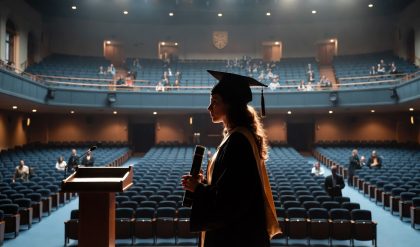
But I had been invited—not as a guest, but as the keynote speaker.
And my name was already on the program he hadn’t bothered to read.
The host stepped forward. The lights dimmed slightly.
“Ladies and gentlemen, please welcome tonight’s keynote speaker—”
I stepped away from the curtain.
“Colonel Dr. Ethel Robinson, United States Army Medical Corps.”
The room didn’t understand the silence that followed.
Not yet.
But my father did.
Because for the first time in years, he stopped smiling.
Part 2: The Woman He Never Prepared For
The spotlight hit me before the room did.
Warm, blinding, absolute.
I walked forward slowly, not because I was nervous—but because control matters more than speed when everyone else is finally catching up.
My uniform was flawless. Dress blues pressed sharp enough to cut glass. Two stars on my shoulder catching the light like they had weight beyond fabric.
And at my side—ceremonial sword, not for threat, but for tradition. For everything I had earned while he was busy rewriting me as failure.
I saw him then.
My father.
For the first time in years, he looked uncertain.
Not angry. Not amused.
Uncertain.
A man who had always spoken in rooms that obeyed him was now trying to understand a reality that didn’t.
I reached the podium.
No dramatic pause. No performance.
Just truth.
“Good evening,” I said.
My voice carried farther than I expected.
“I’ve spent the last eighteen years serving in the United States Army Medical Corps. I’ve deployed in conflict zones most of you only see on maps. I’ve performed surgery under conditions where electricity was a rumor and evacuation was not guaranteed.”
A shift in the room.
The laughter was gone now.
Completely gone.
I continued.
“I’ve held soldiers who asked me to send messages home because they knew they wouldn’t make it. And I did. Every single time.”
A pause.
Not for effect.
For memory.
Then I turned slightly.
And looked at him.
“I was told once that I was playing doctor.”
The words didn’t rise. They landed.
Hard.
“My father said I would come crawling back when reality started. I didn’t.”
A ripple moved through the crowd.
People weren’t sure where to look anymore.
At me.
At him.
At the ground.
At anything but the truth forming in front of them.
“And I think,” I added quietly, “he confused privilege with strength.”
That was the moment everything changed.
Not loudly.
Not dramatically.
But permanently.
I saw his hand tighten around his glass. Then loosen.
For the first time, he wasn’t the most powerful person in the room.
I was.
The host tried to step in, but I raised my hand slightly.
Not to stop him.
Just to continue.
“This gala is not about wealth. It’s about funding medical evacuation programs for deployed personnel and field hospitals.”
I glanced across the room.
“People like the ones my team and I built.”
A pause again.
Then I added something I hadn’t planned to say.
“People like the ones who saved my life when I didn’t think I would make it home.”
Silence.
Real silence this time.
Not polite silence.
Awakened silence.
And then I looked directly at him.
“My father taught me something, though not on purpose.”
His eyes didn’t move.
“I learned that respect given conditionally isn’t respect at all.”
A breath.
“One day, I hope he understands that I didn’t leave him.”
My voice softened.
“I outgrew the version of me he refused to see.”
I stepped back from the microphone.
No final line.
No dramatic exit.
Just completion.
As I turned, I saw something I didn’t expect.
Not applause.
Not shock.
Not anger.
Something quieter.
Recognition beginning where denial used to live.
And for the first time in my life, I didn’t feel like his daughter standing in his shadow.
I felt like an officer standing in my own light.
Behind me, the room finally rose to its feet.
And somewhere in that standing ovation, I didn’t look back to see if he stood too.