When the General Walked In
Part 1: The Sister Who Signed Me Away
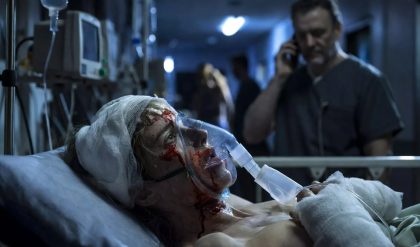
I was supposed to be unconscious.
That was the version my family had already decided on.
A coma patient with no voice, no say, and—according to my sister Vanessa—no future worth delaying.
My name is Captain Eliza Carter, Army Medical Corps. Or at least, I was before the blast in Kandahar changed everything. The doctors called it “unlikely survival with severe neurological risk.” My family heard something simpler: she’s as good as gone.
So they moved quickly.
While I lay in a hospital bed I couldn’t feel, Vanessa filed emergency guardianship papers. My mother supported her without hesitation. My father… stayed silent, which somehow hurt the most. The same people who once called me “the disciplined one” now treated me like paperwork waiting for disposal.
Their goal wasn’t just control—it was access.
My research project, a $12.4 million military-funded breakthrough in combat trauma neuro-repair, was on the edge of FDA emergency approval. Whoever controlled my medical authority would control the data, the patents, and the contracts.
Vanessa had already begun calling hospitals, positioning herself as my “designated medical representative.”
But they made one mistake.
I woke up.
Not fully. Not easily. But enough.
And I remembered everything.
The signatures. The meetings. The way Vanessa stood beside my hospital bed speaking about me like I was already a closed case.
Three weeks later, I requested transport to federal court.
They thought it was impossible.
Then I walked in on crutches.
Part 2: The Man With Four Stars
The courtroom didn’t react at first—like the brain refusing to accept a signal it doesn’t understand.
Then it saw me.
Uniform. Medals. Scars that didn’t exist in their version of my story. Every step I took was a correction to the narrative they had written while I was still breathing through machines.
Vanessa went white.
My mother stood halfway before remembering where she was. My father looked like he had seen a ghost that still had a pulse.
But the real shift came when the doors opened again.
General Marcus Hail entered.
Four stars. No announcement. No escort. Just presence—heavy enough to silence cameras mid-click.
He placed a sealed black dossier on the judge’s bench.
“Your Honor,” he said calmly, “this contains classified medical authorship records, consent chain violations, and unauthorized assumption of control over a serving officer’s intellectual property.”
The judge didn’t open it immediately.
She looked at me instead.
“Captain Carter… are you confirming you were conscious during the period your sister was appointed your representative?”
“I was conscious enough,” I said, “to hear everything.”
That was when the room changed.
Because Vanessa wasn’t just accused of overreach anymore.
She was accused of fraud against federal military medical assets.
My father finally spoke—hoarse, broken.
“We thought we were protecting her legacy…”
I turned slightly toward him.
“My legacy wasn’t dying,” I said. “It was surviving you all deciding I already had.”
The judge opened the file.
Inside: timestamped hospital recordings, signed revocation requests I never authorized, and one final document—
My own signature, proven forged.
Silence spread so deep it felt physical.
The judge closed the file.
“This changes everything,” she said.
And for the first time since the explosion, I believed her.