Part 3:
The relief didn’t last as long as we thought it would.
At first, it felt like silence.
The kind of silence that doesn’t demand anything from you. No footsteps in the hallway. No passive-aggressive comments from the kitchen. No tension sitting in the walls like a second set of lungs.
Just us.
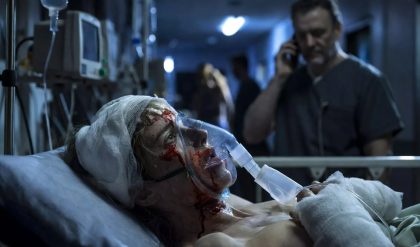
Elena slept for nearly fourteen hours straight in the hospital room. Leo slept on her chest, finally calm, his tiny hand curled into the fabric of her gown like he was afraid the world might try to take her again.
I stayed in the chair beside them the entire time.
I kept expecting my phone to ring.
It didn’t.
That was the part that bothered me most.
My mother was not a woman who accepted defeat quietly. She never had been. Silence, in her world, was never peace. It was preparation.
At 6:12 PM, my phone finally lit up.
Unknown number.
I already knew before I answered.
“Arthur,” my mother’s voice said, sharp and controlled again, as if nothing had happened. As if she still stood in the kitchen carving chicken while my wife lay on the floor. “I hope you’ve had time to calm down.”
I stepped out into the hospital corridor.
“I’m calm,” I said.
A pause.
Then a soft, dangerous laugh.
“You’ve made a very emotional decision. Throwing your mother out of her home. Involving strangers. Embarrassing yourself in front of workers and neighbors. Do you have any idea what people are saying?”
“I don’t care,” I said.
“You will,” she replied instantly. “Because I’ve already spoken to your uncle. And your father’s side of the family. Everyone agrees you’ve been manipulated. That girl—”
“Elena,” I corrected.
Another pause. Shorter this time.
“She is unstable,” my mother said. “And you’re exhausted. New fathers are easily influenced. It’s not too late to fix this.”
Something cold moved through my chest.
“You called my wife unstable after she collapsed from neglect in her own home?”
“She collapsed because she is weak,” my mother said flatly. “And weakness spreads if you allow it. I was trying to strengthen your household.”
That was the moment I realized something important.
She truly believed it.
There was no version of events in her mind where she had done harm. Only versions where she had been disrespected for trying to prevent it.
“I’m done talking,” I said.
“Arthur—”
“I said I’m done.”
I hung up.
For a few seconds, I just stood there in the hospital corridor, staring at the reflection of the vending machine glass.
A man I barely recognized stared back.
Not angry anymore.
Decided.
When I returned to the room, Elena was awake. Her eyes tracked me immediately, searching my face like she was trying to read weather patterns before a storm.
“Was it her?” she asked quietly.
I nodded once.
Elena closed her eyes.
“I don’t want her near him,” she whispered.
“Then she won’t be,” I said.
But even as I said it, I knew that wasn’t the end of it.
People like my mother don’t stop at doors.
They knock until the hinges break.
The first sign came two days later.
A handwritten letter arrived at the house.
No return address.
Just her handwriting.
Precise. Controlled. Familiar enough to make my jaw tighten on sight.
Inside was a single page.
Arthur,
You are making a mistake you will regret for the rest of your life. A wife who turns a son against his mother is not a partner. She is a disruption. You are tired, and grief is clouding your judgment.
I forgive you for your outburst. I expect you to come to your senses soon.
—Mother
Elena read it over my shoulder.
She didn’t cry.
That was the part that hurt more.
She just looked tired.
“She thinks she still owns you,” she said softly.
“No,” I replied. “She thinks she owns the story.”
And then the second wave hit.
Calls. Not from her anymore—but from relatives.
Messages about “keeping the family together.”
Emails about “misunderstandings.”
One even suggested I should apologize first, “to restore peace.”
None of them asked about Elena.
Not once.
Not about the hospital.
Not about the collapsed woman on the rug.
Not about the newborn screaming beside her.
That was when I stopped responding to anyone who shared her last name.
But the real escalation came on the seventh morning.
I was holding Leo in the nursery when the security camera notification pinged on my phone.
Front gate motion detected.
Then another.
Then another.
I opened the live feed.
My mother stood outside the gate.
Not alone.
Two suitcases beside her.
And a small folded stroller.
She wasn’t shouting.
She wasn’t demanding.
She was waiting.
Like someone who had decided that persistence was the same thing as right.
I didn’t tell Elena immediately.
I walked outside instead.
The air was cold enough to sting.
She looked up when she saw me, relief flickering across her face so quickly it almost passed for confidence.
“Arthur,” she said softly. “We need to talk properly.”
“You’re trespassing,” I replied.
Her expression tightened.
“I raised you,” she said. “I carried you. I built your future. You don’t erase that because of one bad day in your marriage.”
“One bad day?” I repeated quietly.
Her voice sharpened.
“She is turning you against your own blood.”
I stepped closer to the gate.
“My wife almost died in that house,” I said. “My newborn was screaming on the floor while you ate dinner. Don’t minimize it.”
A flicker.
Just a flicker.
Then it hardened again.
“She survived,” my mother said. “And now she has you wrapped around her finger.”
That sentence.
That was it.
Not rage.
Not sadness.
Something more final.
I pulled out my phone.
“I’m calling the police,” I said.
Her eyes widened slightly.
“You wouldn’t.”
“I already changed the locks,” I replied. “You already ignored that message. This is your second warning.”
For the first time, she looked uncertain.
Not afraid.
Uncertain.
That was worse for her than fear.
Because fear was something she understood how to control.
Uncertainty meant loss.
She picked up the suitcase slowly.
“You are throwing away your family,” she said quietly.
I looked at her for a long moment.
Then I answered honestly.
“No,” I said. “I’m ending what you called family.”
The police arrived ten minutes later.
She didn’t resist when they asked her to leave.
That surprised me.
As she was escorted down the street, she turned once.
Just once.
Not to Elena.
Not to Leo.
To me.
And for a fraction of a second, I saw something I had never seen in her before.
Not anger.
Not control.
Not pride.
Loss.
Then she turned away.
And walked until she disappeared around the corner.
That night, Elena stood in the nursery doorway watching me hold Leo.
“He’s not going to remember any of this,” she said softly.
“I know,” I replied.
“That’s good,” she whispered.
I looked down at my son.
At the small chest rising and falling against my arm.
“No,” I said quietly. “It’s better than good.”
Elena stepped closer and rested her head against my shoulder.
Outside, the house was finally quiet in a way that didn’t feel like waiting.
For the first time in years, it felt like ours.
Not inherited.
Not controlled.
Not borrowed.
Just built.
And this time, no one who mistook cruelty for authority would ever be allowed inside again.