The Door They Closed, The Legacy They Lost
PART 1 — THE DAY I WAS ERASED
At seventeen, I learned that love in my house was conditional—and I had failed the terms.
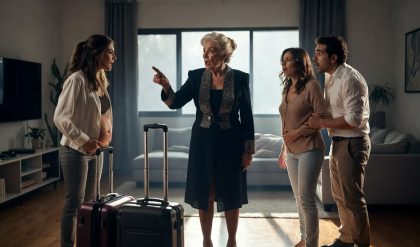
It happened without warning, without shouting, without the kind of dramatic cruelty people expect. My father simply placed a suitcase near the door. My mother avoided my eyes as she adjusted the curtains, as if rearranging the room could erase what was about to happen.
“You’re old enough to manage on your own,” my father said, as though he were discussing a graduation plan rather than exile.
“We can’t afford distractions anymore,” my mother added quietly.
I remember laughing once—just once—because I thought it had to be a mistake. But neither of them corrected me.
The family portrait stayed on the wall, but my reflection in it was suddenly unnecessary.
That night, I walked out with nothing but a coat too thin for the season and a phone that would stop receiving calls before sunrise.
For the first week, I learned what invisibility felt like in a crowded city. People looked through me at bus stops. Shop windows reflected a version of me I barely recognized—someone already edited out of existence.
On the fifth night, I collapsed outside a small bakery that still had its lights on. The owner, a woman named Nora Ellison, stepped out holding a blanket like she had been expecting me.
“You’re going to freeze out here,” she said simply. Not a question. A fact.
I tried to refuse. Pride is stubborn even when it is starving. But she shook her head.
“I wasn’t asking.”
That was the first time someone treated my survival as non-negotiable.
Nora gave me a job cleaning tables, then washing dishes, then managing deliveries. She never asked why I had nowhere else to go. She only asked what I was going to do next.
Months turned into years. I studied at night after closing, sitting in the back room with flour still in my hair and books balanced on my knees. I learned accounting because mistakes cost money. I learned business because silence costs opportunity. I learned resilience because there was nothing else left to learn.
And slowly, the bakery stopped being a rescue point.
It became a foundation.
By twenty-seven, I owned it. By thirty-two, it became a chain. By thirty-five, my name appeared in business journals beside words like “expansion” and “innovation.”
But I never changed the name on the first storefront:
Ellison Bakery.
Because some debts are not financial. They are human.
Then I had a son.
I named him Adrian.
Not because it sounded powerful, but because Nora said it sounded like someone who would survive storms without asking permission.
And he did.
He grew up between ovens and spreadsheets, learning early that success is built from repetition, not miracles. He asked unusual questions for a child—why people fail, why systems break, why kindness is often considered weakness until it saves someone important.
When he decided he wanted to study law, I didn’t argue.
Because I had already seen what happens when people are left without protection.
Years later, Adrian became one of the youngest legal consultants in corporate ethics. His first major case was broadcast on national news.
That was when my past remembered I existed.
PART 2 — THE PEOPLE WHO RETURNED TOO LATE
They arrived on a Tuesday morning.
I didn’t recognize them at first—not because they had changed, but because my life had stopped needing their existence.
My mother wore the same kind of controlled elegance I remembered from another lifetime. My father’s suit looked more expensive than ever, though time had softened the sharp authority he once carried like armor.
They entered the flagship Ellison Bakery headquarters as if they still belonged in rooms they had never built.
“We’d like to speak with Adrian Cole,” my mother told reception warmly. “He’s our son.”
Our son.
A sentence rewritten to sound like ownership.
The receptionist smiled politely. “Of course. He’s expecting you.”
That was not true.
Adrian had not mentioned them.
I was already inside the building when they arrived.
I had been reviewing expansion contracts when I saw them through the glass wall—older, rehearsed, confident in a past that no longer had jurisdiction.
Adrian entered the lobby moments later.
He looked calm. Too calm for someone meeting ghosts.
And then I stepped out behind him.
My mother froze so completely it was as if time had misfired.
“Claire…” my father began.
I didn’t correct him. I didn’t need to.
Adrian looked between them and me once, then spoke first.
“I assume you are here because of the article,” he said evenly.
My mother smiled quickly. “We just wanted to reconnect. Family is important. Especially now that you’ve achieved—”
“Achieved?” he interrupted softly. “You mean the career I built without you knowing it existed?”
Silence dropped like a heavy object.
My father straightened. “We made mistakes, yes, but we are still your blood. That matters.”
Adrian nodded slightly, as if considering a legal clause.
“Blood creates biology,” he said. “Not obligation.”
He turned toward me briefly. Not asking for permission—just grounding himself.
Then he reached into his folder and placed a document on the reception desk.
It was not dramatic. It was precise.
A court-certified record: decades-old termination of guardianship, updated legal injunction, and a new protective order filed that morning.
My mother stared at the paper like it had personally betrayed her.
“This is unnecessary,” she whispered.
“No,” Adrian said quietly. “It’s overdue.”
My father’s voice hardened. “You can’t erase where you come from.”
Adrian met his eyes.
“I didn’t erase it,” he replied. “I outgrew it.”
Security arrived moments later—not aggressively, just efficiently, as if the building itself had already decided the outcome.
My parents turned toward the exit slowly, not because they were forced to rush, but because they suddenly had nowhere important to go.
Before they left, my mother looked at me one last time.
“I only wanted to understand him,” she said.
I answered calmly.
“You had twenty years to learn who I was. You chose not to.”
The doors closed behind them without hesitation.
No thunder. No collapse. Just finality.
Adrian exhaled once, then looked at me.
“Coffee?” he asked.
I nodded.
As we walked away, I realized something simple and irreversible:
They hadn’t returned to reclaim a family.
They had returned to a story that had already finished writing without them.