PART 1 — THE HOUSE THAT WASN’T A HOME
The first thing Daniel heard when he stepped out of the taxi was silence.
Not peace. Not calm.
The kind of silence that comes after something has already gone wrong.
He had been away for three days on an emergency consulting job in Manchester. Three days. That was all it took for his life to tilt off its axis.
He dropped his suitcase inside the hallway of their suburban London home and froze.
A baby was crying upstairs—hoarse, exhausted, relentless.
And somewhere below it, a faint sound of glass clinking against porcelain.
Daniel ran up the stairs two at a time.
His wife, Clara, was sitting on the nursery floor, leaning against the crib. Her hair was tangled, her face drained of colour. Their newborn daughter, Ivy, lay in her arms, screaming so hard her tiny chest shook.
Clara wasn’t responding. Not really. Her eyes were open, but unfocused—like she was there and nowhere at once.
Downstairs, his mother, Evelyn, was humming.
That hum.
Always calm. Always controlled. Always wrong.
Daniel found her in the kitchen, arranging a perfect afternoon tea set on the marble counter. Scones, jam, sandwiches—an entire spread as if nothing in the house was collapsing upstairs.
“You’re back early,” she said pleasantly, not even looking up.
“Where is my wife?” Daniel asked.
Evelyn finally turned, tilting her head. “Resting. She insisted on helping with preparations yesterday. Very determined girl. A bit… fragile, though.”
Daniel didn’t answer. He walked past her.
When he reached the nursery, Clara tried to stand—and failed. Her body collapsed back against the wall like it had simply run out of permission to hold itself upright.
Only then did Daniel notice the faint tremor in her hands. The empty water bottle. The untouched food tray.
“How long?” he whispered.
Clara’s lips moved.
“I didn’t want to disappoint her,” she said weakly.
From downstairs, Evelyn called out sweetly, “Daniel, darling, your aunt is coming for dinner. I do hope Clara has recovered enough to help properly this time.”
That was when something inside him stopped negotiating.
PART 2 — THE DAY THE HOUSE LOST ITS OWNER
Clara didn’t remember leaving the house.
She only remembered Daniel’s arms lifting her, Ivy pressed safely against his chest, and the sound of his voice—low, steady, final.
“No more.”
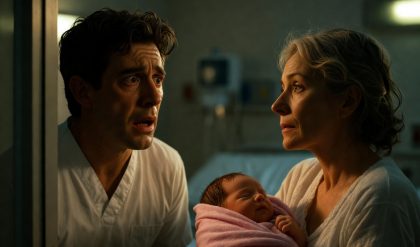
By the time she fully regained awareness, she was in a hospital bed. Warm blankets. IV drip. A nurse speaking gently about exhaustion, dehydration, and postpartum collapse.
Daniel didn’t leave her side.
Not once.
At 2:47 AM, he made a phone call.
At 3:10 AM, another.
At 3:22 AM, he said only four words into the phone: “Change the locks tomorrow.”
By sunrise, the driveway was full.
Two moving trucks.
One locksmith van.
And a manila folder containing legal paperwork Daniel had signed without hesitation.
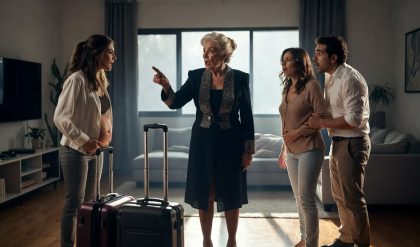
When Evelyn opened the front door, still holding her morning tea, she frowned as boxes began appearing on the lawn.
“What is this?” she demanded.
Daniel stepped out of his car.
Calm. Exhausted. Certain.
“This is the end of your stay here.”
A pause.
Then Evelyn laughed. “You can’t be serious. I raised you. I shaped this home. That woman upstairs is incapable of running anything properly—”
“Stop,” Daniel said quietly.
Not loud. Not angry.
Final.
He walked past her into the house and began opening drawers himself.
Every item his mother had brought—clothes, jewelry, porcelain, even the guest room bedding—was placed into labeled boxes.
“You’re choosing her over your own mother,” Evelyn hissed behind him.
Daniel didn’t look back.
“I’m choosing my wife and child over someone who thinks exhaustion is laziness.”
By mid-morning, everything she owned was gone.
By noon, the locks were changed.
By afternoon, Clara was sitting up in bed, holding Ivy for the first time without shaking.
When Daniel returned, he placed a single set of keys into her palm.
“Our home is ours again,” he said.
Clara stared at them for a long moment—like she didn’t trust something so simple.
Then she cried.
Not from pain.
Not from fear.
But from the first real feeling of safety she had experienced in months.
And outside the hospital window, the world finally felt like it had stopped breaking.